Showing posts with label beauty. Show all posts

Thursday, August 27, 2020

No ordinary island


Pandemic be damned, it’s summer. And summer means vacation. Because this is France, and liberté-égalité-congés payés is what. As for myself, I may never truly be on vacation again because I am self-employed, but Covid-19 has suddenly placed new emphasis on the free aspect of freelance, so sure, bailing for several weeks is fine.

Normally, my parents were due for a visit this summer and we were all going to Ireland, but the whole 2020 pangolins-bats-yada yada-cough cough-touch nothing-go nowhere-viral armageddon kind of threw a wrench into that. Plus President Macron told us to behave and stay (relatively) close to home.

Us: Corsica is technically in France. Let’s go to Corsica!

When in Corsica, one definitely needs a car. So we decided to cross nearly the full length of the mainland and take a ferry docked in Nice, thus keeping our car and avoiding the airport. The very thought of the airport sends my cortisol levels through the roof. Maybe because of multiple experiences such as this one.

Sure looks good from here.
Parking on the ferry was interesting. Its staff for some reason was made up of 100% irate Italians, barking barely recognizable orders as we maneuvered our way onto one of the lower decks. I don’t know what madman came up with the parking plan on this thing, but the cars were crammed in so closely together that we couldn’t so much as open either of the doors on the right-hand side. Weird. Somewhat barbaric. Borderline panic-inducing. Oh well!

The crossing took six hours, which maybe would have been OK with the kids if the on-board activities and attractions had been open, but thanks to our pal Coronavirus, everything was closed. The whining commenced almost immediately.

Dear son: Mom this boat sucks so muuuuuuch! There’s nothing to doooooooo!
Me: Do you know what you sound like right now? Like an overprivileged white kid with first world problems. You are lucky and I mean really lucky to be voyaging across the Mediterranean with your sister and two parents who love you while other kids out there are hungry or homeless or caught in the midst of war—do you hear me?—WAR!  
Dear son: *stares blankly at me*
Me: Oh never mind. Here’s half a Twix.
Dear son: *smiles*

Exiting the boat was hellish. Actually, scrap the -ish. It was straight-up hell. Dark, hot, crowded, airless, and definitely not compliant with social distancing measures. It was bad. They really need to rethink that whole park-on-top-of-your-neighbor concept. But we lived. Next.

The first week, we stayed in Lumio, a charming hillside town overlooking the sparkling Bay of Calvi, and also the home of supermodel Laetitia Casta (who knew?). The rental was fab:


Each day, we explored northern Corsica to the best of our abilities. We took twisty windy hold-onto-your-faith-with-both-hands cliffside roads with breathtaking (and potentially life-taking) views. We discovered the UNESCO world heritage site of Scandola, with its turquoise coves and rainbow rock formations:


The kids dug it:


We ventured onto secret beaches and swam in natural pools. We enjoyed picnic lunches and al fresco dinners. We caught some lizards and a few sea critters. We scraped the finish off the side of our car on a giant yucca. We ate some exceedingly pungent cheese. We visited perched villages in the 90° heat.

The kids dug it:


Northern Corsica is rugged and wonderful, surrounded by turquoise water and vegetation that looks surprisingly similar to that of San Diego (represent!). It also has simply incredible rock. Quartz, limestone, rare pink granite, basalt. Gorgeous. Every river, every beach, every natural pool is a treasure trove of multi-colored boulders and pebbles:

I’m hooked on macro photography, for better or worse.
Only downside: the heat. I don’t do heat (I don’t really do cold, either, but that’s a topic for another day). In fact, the older I get, the less I do heat. At least when it’s cold, you can put on an extra sweater. But when it’s hot, all you can do is stand in front of the A/C or go swimming. So we stood in front of the A/C and went swimming. A lot. I actually ended up with a tan, which totally flies in the face of the whole Scandinavian vibe I usually have going.

At sunset, we would climb up to our rooftop terrace with a view of the bay for apéro, every surface still radiating the day’s warmth, crickets chirping, the lights of Lumio twinkling on the hill behind us and the stars sparkling above. It was otherworldly.

Then suddenly, a whole week was over and it was time to head south. Despite its modest size, Corsica has a remarkably rich and varied landscape; we traded the golden cliffs and Californian vegetation of the north for the sandier, balmier, more Côte d’Azur feel of the south (which is somewhat bizarre considering we were farther than ever from the actual Côte d’Azur, but OK).

Our next rental was also nice, although less “authentic” than our first. It had a little cubby hole kids’ room accessible via a really dangerous-looking ladder, a classic example of what the French would call a fausse bonne idée (an idea that seems good at first but is actually a curse in disguise). The A/C was right on the money, though, so we just upped our level of vigilance by about 200%:

What lawsuit?
Our “mini villa” (*grabs dictionary, looks up oxymoron*) was also in close proximity to some of the world’s most beautiful white sand beaches, so we hit the beach and I mean HIT IT. Lots of sand and sun and more sand and more sun! I got even tanner! My pale-faced ancestors were surely spinning pirouettes in their graves!

We also visited the southernmost tip of the island, a splendid city called Bonifacio. Magnificent scenery. I took roughly 200 photos because how could you not? Many of them were macro shots of flowers and the famous Corsican maquis, but I will spare you!


One of the “musts” in Bonifacio is a staircase carved into the side of a cliff known as the Staircase of the King of Aragon, which is a secret passage to a natural spring with fabulous views of the sea. According to legend, it was built by said king’s troops during a siege one night in 1420, although the truth is that it was probably built by monks (which is just the absolute opposite of the legend, but whatever!). In any case, after donning protective gear and completing the visit, I came away feeling highly dubious that any king, legendary or otherwise, ever huffed it up and down this killer staircase. Pity his servants and water-bearers, although I’m sure their rear ends were as finely chiseled as those 187 steps.

The kids dug it, bien sûr:


And lest I forget a personal highlight, mountain child that I am: Corsica is also blessed with absolutely glorious mountains. In fact, so mountainous is the island that it is often referred to as une montagne dans la mer (a mountain in the sea). So many ridges and peaks to choose from! We explored just a smidgeon, but I’d gladly have lingered far longer. I mean look at this:


An extraordinarily magical, mystical land altogether. Being a fervent admirer of all things Tolkienian, and in the midst of reading The Silmarillion with the utmost relish, Eru Ilúvatar, Varda, Ulmo et al. were on my mind quite a bit throughout our travels.

Corsica or Middle Earth?
In conclusion, and if I may wax profound for just a minute here—Corsica took my breath away. I have been travelling around France for nearly 20 years now, and have discovered countless things to love, but this island had an entirely different, deliciously unique feel to it. In Corsica, the imprint of French Civilization is far less overwhelming than it is on the mainland, where art and architecture speak passionately and eloquently of human history, of human achievement. In Corsica, the roles are reversed: structures, however handsome, are ultimately mere props; Nature is the true star of the show. Polychrome rock. Spirited wind. Fiery sun. Crystalline water. They spoke deeply and powerfully to me on this trip, cutting through the layers of suppressed anxiety and accumulated mental clutter. 

In these strange and often surreal times, the “new normal” for many of us is one of uncertainty, of disorientation, and a gnawing fear that the Covid-19 crisis is but a warning shot. Yet these timeless elements of earth and air, fire and water, which existed long before we arrived and will endure long after we have departed, are a reminder that perhaps our view of our own lives has itself become too “macro.” Perhaps we need to zoom out, shift our focus off of our little selves, forget our all-important problems for a while, and remember that we are part of a much larger picture. We and All That Is are made of the same stuff—are works by the same Artist. Checking in with the heart, reconnecting with the present is simple: hear the rustle of wind in the trees. Slip one foot, and then another into a cool brook. Close your eyes and feel the sunshine on your face. Ultimately, what makes me feel safer, healthier, more in touch with life itself: checking my Twitter feed for the umpteenth time, or lying in silence on a warm boulder, listening to the sound of water flowing over pebbles? Maybe the key to soothing a weary soul really is as easy as that. Contentment doesn’t have to be fleeting. 

Someone should tell my kids.

Friday, September 21, 2018

A life uncommon: part III


I followed my bliss all the way to Paris on September 7, 2001, arriving with an overstuffed suitcase and a heart full of hopes, dreams, unavowed fears, and the inexplicable assurance that I was where I was meant to be. In honor of the 17th anniversary of that leap of faith, I have decided to write a short series of posts recounting the little-known tale of my love affair with France. 

Read part I here and part II here.


Egalité

After a two-year honeymoon period, a bit of disenchantment slowly began to creep into my French utopia. Taking stock, I was 23, earning scarcely more than minimum wage, still single and not making any headway in that department.... But mostly, I was fed up with feeling inferior. I’d worked assiduously in college and had graduated with high honors—departmental distinction, Phi Beta Kappa, Summa-Cum-freaking-Laude for Pete’s sake! What was I doing fetching coffee and fielding angry phone calls from people I only barely understood? Where was the appreciation—and the salary—I felt I deserved? And where in blazes was l’amour? I had had enough of playing the endearing but inconsequential American ingénue. But then, what was the alternative? Quit? Go back to the US with my tail between my legs? Prove the naysayers right? No way, André.

My non-renewable work permit was drawing dangerously close to its expiration date when my boss invited me into his office and said that he would be willing to sponsor me if I wanted to stay. WHAT?! Sponsorship was the only way I could keep working legally, and it was a big deal. From the very beginning of my quest to live in France, people warned me how difficult it would be to find a sponsor—essentially a French company both willing and able to prove to the government why I should be hired and not one of the country’s many native job seekers. With unemployment a perpetual hot-button issue, a foreigner like me being given the go-ahead to “take” a position at a French company was far from a foregone conclusion.

Suddenly I didn’t mind fetching coffee quite so much.

Being sponsored for an employee visa meant going home to California for four months while the paperwork was being processed. It also meant explaining myself to my parents, who had never intended for that one semester of studying abroad to morph into my life’s calling. “God works in strange and mysterious ways,” I airily reminded them, promising that if one day France rejected me, then I’d move back to the US—but so far that hadn’t happened; on the contrary, everything seemed to be falling into place. Being in California in the autumn of 2003 also afforded me the extremely unpleasant opportunity to experience the great Cedar Fire, a conflagration of epic proportions that destroyed thousands of houses and very nearly wiped out my entire hometown. My parents and I had to evacuate for 10 days, returning to a charred, nightmarish landscape steeped in smoke. That was not the high point of my visit home.

I flew back to France, chastened, in January of 2004—and proceeded to have my heart stomped good and flat by my first French boyfriend, who also happened to be my boss’s eldest son. That was not the high point of my return.

Vowing not to cast any more pearls before any more swine, I soon resumed my lighthearted Parisian existence and tried to shrug off any dreams of professional grandeur. After all, even if I was confined to office work, how could I dare complain when I had the City of Light? Henri IV himself had had to make a sacrifice or two in exchange for her—Paris vaut bien une messe! Still, that nagging voice in my head wouldn’t quit. “WHAT are you playing at?!” it hissed. “You have no money! Your career is going nowhere! You can’t bury your head in the sand forever! TICK-TOCK.” Finally, I had to admit that the voice was right. I couldn’t stay at that job any longer; it just wasn’t enough. And while it had enabled my French to reach heights I’d never imagined, and had certainly taught me the fine art of getting along in a French company, I was thirsty—very thirsty. I yearned to excel, to achieve, to stop scrubbing the proverbial floor and put on the damn proverbial glass slipper.

But in a country where it is customary to name-drop one’s alma mater early and often, sometimes going so far as to include it in one’s signature, acquiring the proper academic credentials is nothing less than imperative if one is to entertain even the faintest hope of squeezing one’s foot inside the door of any major company. And as far as my American accomplishments were concerned, France neither recognized them nor cared; in the eyes of the Powers That Be, I was pretty much a nobody. I would be less than candid if I said that didn’t hurt, since it did—rather a lot, actually. But like it or not, I had to accept the fact that if I ever expected to achieve any semblance of égalité with the French, I would have to humble myself before the gods of academia and return to school, in France. Wounded ego notwithstanding, part of me was relieved: thinking about graduate school felt good. As the daughter of two teachers, the classroom had always been a second home of sorts; maybe returning to school would at last grant me the opportunity to shine in a country that I felt was still waiting for me to prove my worth.

So it was settled—I would trade in my highly coveted employee visa for a lowly student visa. It is difficult to express the magnitude of the gamble that such a decision represented: I was essentially giving up my “safe” status as a worker bee and betting my entire future in France on a Master’s degree, or rather, on my ability to persuade another French company to go through the whole employee visa sponsorship process again once I had completed said Master’s degree (was I crazy? Yes ... crazy like a renard!).


Going back to school also meant assuming a fair amount of student debt, which only added to the already considerable pressure I was placing on myself to make this degree THE magic bullet. I’d lived in France long enough by then to know that the outcome of my wager would hinge on two factors: what I studied and (more importantly) where I studied it. The highly respected Grandes Ecoles (France’s Ivy League) were therefore the only acceptable prospects, but their admissions process was rumored to be draconian. To further complicate matters, it was fairly obvious that business school would be my best bet if I wanted to play ball with the big kids, but a business degree seemed somehow wrong for me. Tricky. Then again, I’d double-majored back in college: art history and advertising. Surely introducing some business acumen to either field would pry open a few sealed doors; I just had to pray that one of them would be the right door.

TO BE CONTINUED…

Photo by Lily Heise

Friday, September 14, 2018

A life uncommon: part II


I followed my bliss all the way to Paris on September 7, 2001, arriving with an overstuffed suitcase and a heart full of hopes, dreams, unavowed fears, and the inexplicable assurance that I was where I was meant to be. In honor of the 17th anniversary of that leap of faith, I have decided to write a short series of posts recounting the little-known tale of my love affair with France. 

Read part I here.


Afoot and light-hearted

My life in France began in earnest when the United Airlines flight touched down at Charles de Gaulle airport on a perfect September morning in 2001. Destiny, it seemed, was on my side; I’d been offered a living situation that couldn’t have been more perfect if I’d dreamt it up myself. Once again, it had materialized out of nowhere at precisely the right moment. A mere few weeks earlier, I was at a theater in San Diego with my parents and some family friends, lamenting the fact that I had no housing solution for my Paris work abroad program. At intermission, a couple seated in front of us turned around—they just so happened to know my parents’ friends and had obviously overhead my whining. “We may be able to help,” they said. And before long, I was holding the keys to a beautiful Parisian apartment a mere 10-minute stroll from the Arc de Triomphe. 

So, I had a place; I had a visa; I had a plane ticket. I just needed a job. The organization in charge of getting me to Paris kept records of every French company that had ever hired one of its participants, so I rifled through its binders and jotted down everything that seemed remotely interesting. But then came the moment when I had to actually call some of these people. Summoning the courage to pick up the phone and speak, in mediocre French, to a bunch of perfect strangers in an attempt to convince them to grant me a face-to-face interview was just the sort of thing we introverts have nightmares about. However, it was also necessary, so I swallowed my pride and did my best to not sound like a blithering idiot. A few near misses later, I struck gold—an American expat who owned an art gallery on the exceedingly fashionable rue du Faubourg Saint Honoré, virtually next door to the presidential Palais de l’Elysée, agreed to hire me—ME!—I about died.

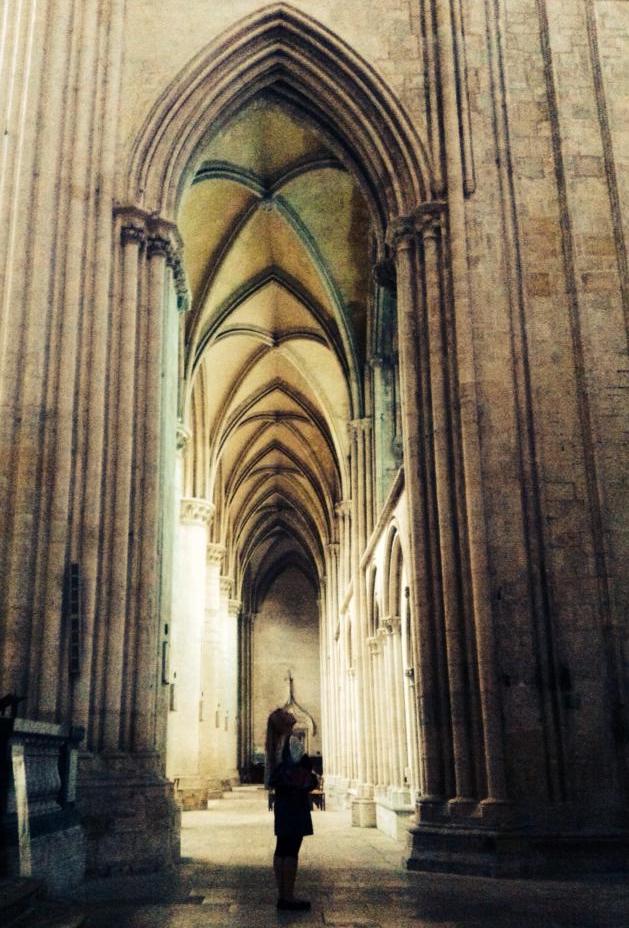
All that was left was to make some friends. And that prayer was soon answered too, in the form of a little group of Canadian kindred spirits pursuing dreams not unlike my own. Thanks to them, I finally discovered some of what Paris had to offer in the way of social life. I worked five days a week at the gallery and spent nearly every weekend travelling. Chartres, Amiens, Beauvais, Senlis, Laon…. I visited every great Gothic cathedral within a few hours of Paris, and then ventured further afield, almost exclusively by myself. I slept in youth hostels or cheap hotels, ate alone in carefully-researched restaurants, read my trusty guidebook cover-to-cover—and savored every minute. When in Paris, my friends and I dined out, took in movies and plays, and drank quite a bit of wine. I was happy once more. Exceedingly happy. But despite that, a nagging fear remained in the back of my mind: what would I do in December, when my non-renewable work permit expired?

My first impulse was to level with my employer. As a fellow American and art lover who had moved to France in her youth, we had several things in common; surely she would understand my desire to remain in Paris. “Oh, everyone says that,” was her dismissive and frankly disappointing response. I bristled. This woman clearly had no idea who she was dealing with. Thankfully, one of my dearest friends, and a highly skilled problem-solver, pointed me to an 18-month “professional internship” program that would allow me to keep living my dream—just so long as I could find an employer willing to do the paperwork. Destiny went to bat for me again, and that elusive employer appeared in the form of a Franco-Russian publisher who had recently hired an Irish friend of mine and was looking for a bilingual assistant. Not quite the stuff of dreams, but hell, at that point I’d have accepted street sweeping if it meant I could stay.

And so my adventure was given the green light to begin a whole new season. This one was marked by another desperate search for an apartment, since my too-good-to-last rental agreement near the Arc de Triomphe had to come to an end. The Parisian housing market is notoriously difficult, and being a foreigner did me no favors. I visited something like 40—FORTY—different places. Many were “reserved” or off the market before I got there; most were too expensive to begin with. Some were shockingly small; others were shockingly decrepit. One of the more memorable visits was essentially a crumbling hallway overlooking a cemetery. Nonetheless, I kept at it. In the meantime, I house-sat, crashed on the couches of friends and then friends of friends, hid out for a month in a bedroom in the suburbs, and tried not to lose hope. Finally, finally, my new boss’s wife put me in touch with the owner of a one-bedroom just behind Montmartre, who agreed to take a chance on me. Sure, it was an 86-step hike to the top floor of a not-so-nice building in a so-so part of town, but it was MINE ALL MINE! A new coat of paint, a few unlikely furniture acquisitions, an oversized Robert Doisneau print to reign over it all, and voilà! One happy, homey, truly cosy Parisian abode.

I was elated. Forging ahead. Living the dream. What could go wrong?

TO BE CONTINUED...


Friday, September 7, 2018

A life uncommon: part I


I followed my bliss all the way to Paris on September 7, 2001, arriving with an overstuffed suitcase and a heart full of hopes, dreams, unavowed fears, and the inexplicable assurance that I was where I was meant to be. Today is the 17th anniversary of that leap of faith. To mark the occasion, I have decided to write a short series of posts recounting the little-known tale of my love affair with France. We American expats are not so numerous as one might imagine. Those of us who go abroad and remain abroad all have very personal reasons for doing so. 

Here are a few of mine.


Liberté

Their lined paper is so … *liney*, thought 8-year-old me, leafing through the French notebook I’d received from a friend who’d just returned from Nice following his dad’s short-term teaching exchange. Years later, in high school, I would choose to study French over Spanish, under the guidance of that very same friend’s dad (hi Mr. Johnston!). My parents joke that he is to blame for awakening my love for France, but really, the dream was there to begin with: I was certain that France was some kind of fantasy land graced by castles, cathedrals, and surely a bit of Deep Magic from before the dawn of time. Attempting to master the language as an adolescent was a humbling experience, but after four years of grappling with irregular verbs and impossible strings of vowels, I was college-bound and had every intention of spending a semester studying abroad in Paris.

Well.

A bashful, hopelessly romantic, straight-A art history major like me never stood a chance of resisting France’s legendary powers of seduction. The flight from Dallas I shared with 39 fellow SMU students in late August of 1999 hadn’t even landed when already I sensed a shift in my personal space-time continuum. As the plane descended, I gazed down on a patchwork that looked nothing like the neat American checkerboard I was used to. This looked ancient. Mysterious. Old World. The airline lost my luggage; I barely noticed. I floated out of Orly airport and onto a bus, which took us to picturesque Fontainebleau. Everything seemed miraculous to me: the crisscrossed rattan of the chairs adorning every sidewalk cafe, the canary yellow mailbox perched on a street corner, the hardboiled egg slices peeking out from my first baguette sandwich. I wrote my parents a postcard from the gardens of the highly enchanting Château Vaux-le-Vicomte, gazing dreamily at a perfectly manicured lake dotted with perfectly manicured swan boats, and knew that some part of me had already decided. I wasn’t going back—this was True Love.

I have always preferred Paris in the autumn, perhaps because it was autumn when we first met. After a week of orientation outside the city, my classmates and I were driven into the heart of the Latin Quarter to enjoy a welcome cocktail with our host families. “See those leaves?” asked a visiting professor from Texas, motioning to the mottled foliage of the elegant chestnut trees lining Boulevard du Montparnasse. “That’s what they call l’automne.” All of us descended from the bus, and I redoubled my efforts to resist gaping, open-mouthed, at everything inside Reid Hall, the stately 18th century former porcelain factory that would be our school for the semester. I clearly remember pinching myself, and then laughing under my breath because who actually does that? And then we met our host families. Mine was perfect, obviously. They were kind, and cheerful, and very forgiving of my pathetic language skills. Fun fact: I’ve remained friends with them to this day, and they still delight in reminding me how awful my French was so long ago. That’s what families do—even host ones.

For four months, I lived in absolute bliss. Classes were held alternately at Reid Hall, alternately inside the Louvre (!!!). Or the Musée d’Orsay. Or the Musée Pompidou. Or simply out and about in Paris. The art historian in me was euphoric. I walked all over the city, rain or shine, scrupulously recording each day’s discoveries in my diary each night. I took trips across France: to the east, the west, the north, and the south. “Everything here is so beautiful,” I gushed. People just laughed. She has it bad, they must have been thinking. They were right—from the Chagall windows in the Metz Cathedral to THE Impression, Sunrise at the Musée Marmottan; from the Roman amphitheater in Arles to the Rothschild gardens on the Côte d’Azur; from my first encounter with the Eiffel Tower in all her glory to the sensory rapture that is a Provençal market, I was gone, gone, gone. Smitten. Love-struck. Over the moon.

Reality slapped me across the face—hard—when the semester came to an earth-shattering conclusion in late December and I had no choice other than to return to “normal life.” My mind reeled. The flight home was a weepy blur. My poor parents didn’t understand what was wrong with me. Why wasn’t I happy to be home? Didn’t I have a good time? YES—far, far too good! Those first few months back in the US were a masterclass in pain. I felt so heartsick I didn’t know what to do with myself other than search high and low for some way—any way—to return to my beloved France. I was treated to a lot of oh-everyone-says-that and oh-everyone-loves-Paris, which naturally only cemented my resolve to not be like “everyone.” 

Halfway through my senior year, while my entire graduating class seemed to have internships, job offers, and juicy MA programs all lined up, my standard response to the dreaded question of what I was planning to do after graduation remained a falsely confident “move to Paris,” which always drew a raised eyebrow, an awkward laugh, or a condescending “good luck.” Except for one of my favorite art history professors, that is, whose unexpected response was an earnest “take me with you!” Those words were really all I needed to hear—why stay and go the academic route like everybody was pushing me to do, when this professor whom I admired so much was clearly in agreement with what my heart had been telling me all along?

In the eleventh hour, as has so often been the case in my life, a way was made where there seemed to be no way. My own Red Sea moment. Right behind the university, no less, were the modest offices of Council Travel, which offered none other than work exchange programs, including to France, for recent graduates. EUREKA! Letter of acceptance in hand, I graduated Summa Cum Laude from SMU in 2001, threw a shaky French résumé together, and promptly moved halfway around the world—where I had no job, no friends, and where no one gave a damn about my degree, my accomplishments, or my qualifications. But those were mere details to me at the time. What mattered was that I’d proven the naysayers wrong: I was libre to pursue a very unique version of the American dream.

TO BE CONTINUED...


Illustration by Corey Egbert

Sunday, June 19, 2011

An ode to acrylics


Ten days before my wedding, which is to say toward the end of April, I marched into an empty nail salon in Southern California and requested a full set of acrylic “French tip” nails. I’d been toying with the idea for months, as “What am I going to do about my NAILS?” is a question that every self-respecting bride-to-be asks herself at some point. I’d begun early: interrogating my loved ones, scouring the web, consulting my inner child.... Most opinions were negative, acrylic nails being notoriously rough on one’s natural nails (really? You mean cementing prosthetics to one’s hands and then covering them with three layers of foul-smelling resin is harmful?). But there is no such thing as natural beauty—at least not in the world of nail art—so I paid no heed to the naysayers. Besides, I wanted gorgeous hands for those wedding photos and no way was I going to settle for a basic manicure. I wanted to go whole hog. I wanted my Steel Magnolias moment.

Thus, on a sunny Wednesday, in I strolled into my chosen nail salon and within minutes was seated comfortably facing my nail technician, a portly Vietnamese lady wearing a gaping, washed-out tank top that left little to the imagination and kind of made me feel overdressed. One other client was there —a 40-something character named Linda, the kind of woman who just hangs out in nail salons: big hair, loud makeup, ocher skin and a smoker’s voice. She wasted no time in announcing that she had a blind date in an hour, and had come over to get ready. She also fully intended to choose an outfit while at the salon, and thus had brought along several possibilities to model for us. This initially struck me as surreal, but a few blinks of incomprehension and I was over it. Besides, the surreal seems to follow me wherever I go—so why not here? Otherwise, the salon was fairly classic: rows of reclining pedicure chairs, little tables adorned with manicure lamps, displays of brightly-colored nail polish and a big flat-screen TV. In this case, the channel was set on Disney. I figured there must be a small child hiding in the room somewhere—a daughter perhaps?—but no, my nail technician just had a thing for Hannah Montana. Who doesn’t?

That and gambling. As it turned out, acrylic nails are actually quite labor-intensive, which left us plenty of time for light-hearted banter. So as she proceeded to glue 8-inch-long appendages to my nail bed (step #1), I lent a polite ear to sordid tales of gambling away her livelihood at the big casino over on the nearby Indian reservation. Not that I had any choice in the matter—I couldn’t very well get up and walk out looking like Edward Scissorhands, plus I really needed her to do a good job. So I shut up and listened.

Apparently, she had begun hitting the game tables ages ago, not long after arriving in the US as a Vietnamese refugee(?!).

“I used to play all the time. Sometimes I lose. Sometimes I lose a lot. My husband, he no like it when I lose. You know, hundreds I lose, sometimes thousands (laughs). He get real angry when I do that.”

“You don’t say,” I answered.

“It used to be real bad but now is better. Now I play, but not all the time. Sometimes I win. But also I lose (laughs).”

“Interesting,” I said.

“Do these pants make me look fat?” interrupted Linda.

Three and a half hours later, I felt as though a certain level of intimacy had been established between us. Upon leaving, I almost wanted to give her a hug and encourage her to stay away from the casino. But instead I gave her a nice tip, hoping it wouldn’t end up where I was imagining it would.

And in the end, I didn’t regret my choice. My nails were impeccable for the wedding and remained so for the honeymoon. In fact, I grew so fond of them that I had them “refilled” upon my return to Paris, which was almost as amusing as the initial operation. Nail salons here tend to double as erotic message parlors, which kind of makes sense. I mean, men have to do something while the ladies have their nails done—thumbing through magazines is just so prosaic. Incidentally, women can also get massages at these fine establishments, but the cost for men is always significantly higher. Now why would THAT be...?

But dubious salons aside, I’m still loving the fake nails. Why? Because they’re flawless! I mean sure, they do make a hell of a lot of noise when I type, but otherwise it’s pure pleasure wearing them. They’re unbreakable, unsplittable, unsulliable; I haven’t so much as caused one tiny run in my stockings since I had the nails put on and that alone is well worth the cost. Plus they’re still relatively rare in France, which is a nice boost for my ego.

The ONE downside is that they’re ... um ... flammable. I found that out the hard way while lighting a candle the other evening. Suddenly it was my thumbnail that was twinkling away and not the wick. “What’s that smell?” G. asked. “Nothing!” I said, trying to hide my singed nail. Oh, it was fine. I filed it down a bit and it was good as new. Mostly.

So in conclusion, I give two singed thumbs up to acrylic nails. Sure they’re somewhat dangerous. But in the end ... aren’t we all (philosophical pause)?

Wednesday, March 17, 2010

Zen and the art of grocery shopping


Today I would like to discuss one of my favorite activities—grocery shopping. I’m serious. Wandering the aisles of the local supermarket has always afforded me a peace of mind akin to that of a long stroll through a flower garden, or the silent contemplation of raked gravel. In college, when most of my fellow student-types were off engaging in more conventional forms of decompression, I could often be found lingering in the aisles of the local grocery store, collecting my thoughts while hunting for exotic sauces. Zen meditation or supermarket cruising—both do wonders for my sense of inner calm.

Land of food, France and its grocery kingdom were just waiting for my arrival. When I first moved here, I couldn’t get enough of grocery shopping—which was inconvenient considering I was living with a host family and had no refrigerator of my own, but that is beside the point. All I knew at the time was that in France the grapes looked different, the cucumbers looked different, the yogurt aisle was like something out of a dream ... and they had this crazy system where you weighed your own produce and printed out your own little labels with the prices right on them! How exciting! Now, many years later, I admit that the element of novelty has worn off (yeah, yeah, so the zucchini are round), but I still love to grocery shop.

The funny thing is that whereas in the beginning I celebrated all the new, strange and wondrous things that I could find and buy in French supermarkets (fromage blanc, for example, or liqueur de litchi, or pâtes d'Alsace...), today I get excited when I stumble across beloved “American” items that I had assumed I would never see on this side of the Atlantic. I’m thinking baby carrots; I’m thinking Special K; I’m thinking SMOOTHIES. Yes, after long years of bitterly lamenting their absence, my craving for pureed fruit drinks can at last be appeased—smoothies are now an accepted member of the French supermarket club. Thank you, Tropicana. In fact, smoothies have garnered quite a following in Paris. And what with the bagel bar that has recently sprung up next to my office, I feel nearly as though I’m at home in SoCal (well, kinda).

So my question now is: what on earth are smoothie shops like Jamba Juice and Surf City Squeeze waiting for? It is high time for them to go French. And before you get all up in my grill for advocating chain stores and industrial food and all that everyone loves to hate about America, I’d like to point out that this is no longer 1930 and France has so many of its own chain stores that no one bothers to do any hand-wringing over the presence of big, mean Starbucks anymore. Simply take a stroll along the Boulevard des Italiens in the center of Paris and THEN let’s discuss chain eateries. Or take a gander at the zones commerciales peppering the provinces. Honestly, France requires zero help from the US to go franchise. Hence my dream of opening a Bath and Body Works here and retiring at age 40, because believe me, all they need to do is tone down a bit of that cutesy barn look they have going and French women will be all over them. Witness Sephora, the Body Shop and Yves Rocher. Creams and lotions are of international interest. Much like round zucchini.